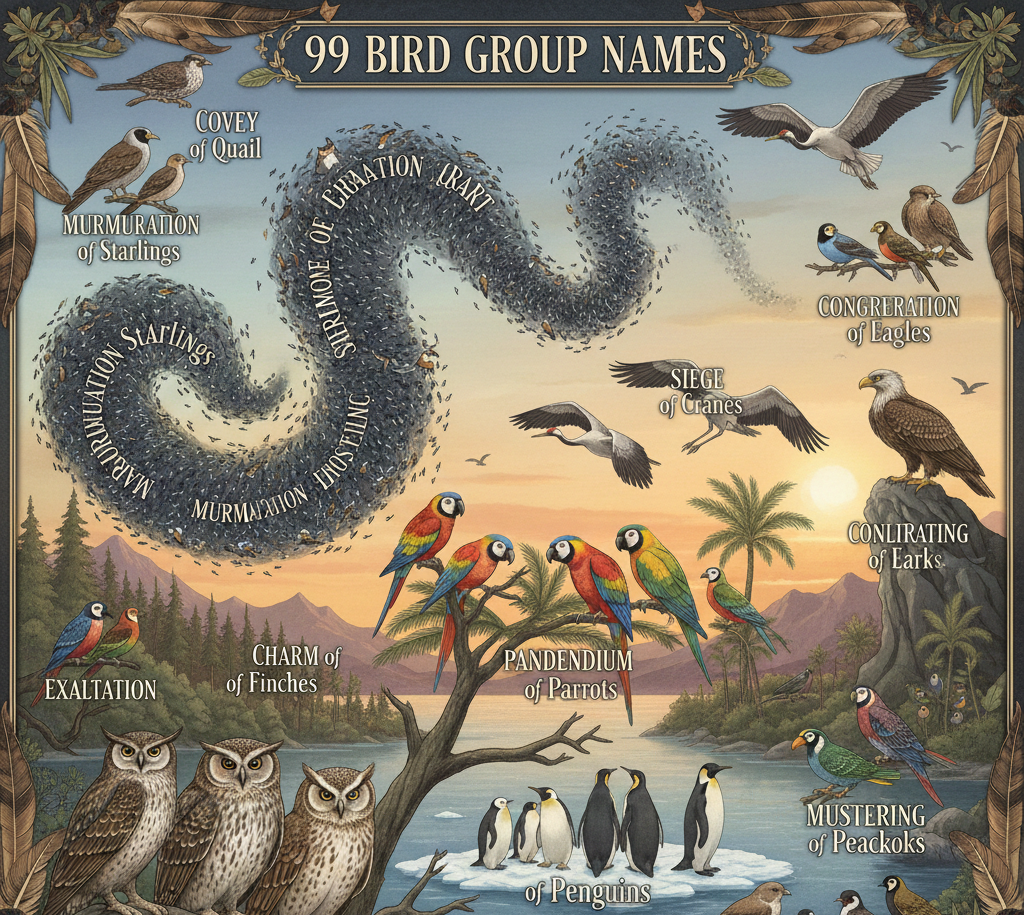

Have you ever wondered why a group of crows is called a murder or why starlings form a murmuration? Bird group names are one of those fascinating corners of language where nature, history, and imagination collide. In this guide, we’ll explore 99 bird group names, explain what they mean, and share why these collective nouns exist in the first place.
If you’re a bird lover, writer, student, or just curious, this list of 99 bird group names will give you both knowledge and fun facts you’ll actually remember.
What Are Bird Group Names?
Bird group names are also known as collective nouns. They describe a group of the same species gathered together, whether flying, feeding, or resting.
Some names are scientific, others poetic, and many come from medieval hunting traditions where colorful language was encouraged. Today, they’re widely used in birdwatching, literature, and trivia.
Why Do Birds Have So Many Group Names?
Birds behave differently depending on species, season, and environment. Over time, people noticed these patterns and gave them names that matched:
-
Behavior (like swirling flight)
-
Sound (chirping, calling, or singing)
-
Personality (aggressive, quiet, social)
-
Appearance (size, color, or movement)
That’s why bird group names feel so vivid and memorable.
The Ultimate List of 99 Bird Group Names
Below is a carefully researched and organized list of 99 bird group names, grouped for easier reading.
Common and Well-Known Bird Group Names
-
Flock – General term for most birds
-
Flight – Birds flying together
-
Colony – Nesting seabirds or shorebirds
-
Roost – Birds resting together
-
Covey – Quail or partridge
-
Brood – Young birds with parents
-
Clutch – Eggs or hatchlings
-
Nest – Birds living together
-
Gathering – Mixed bird species
-
Congregation – Large resting groups
Famous and Unusual Bird Group Names
-
Murder – Crows
-
Parliament – Owls
-
Murmuration – Starlings
-
Unkindness – Ravens
-
Exaltation – Larks
-
Charm – Finches
-
Tidings – Magpies
-
Conspiracy – Ravens
-
Kettle – Hawks in flight
-
Pitying – Turtledoves
Water Bird Group Names
-
Raft – Ducks on water
-
Paddling – Ducks
-
Plump – Geese on land
-
Gaggle – Geese on ground
-
Skein – Geese in flight
-
Pod – Pelicans
-
Fleet – Pelicans in flight
-
Scull – Gulls
-
Colony – Penguins
-
Waddle – Penguins on land
Birds of Prey Group Names
-
Aerie – Eagles
-
Convocation – Eagles
-
Kettle – Vultures
-
Wake – Buzzards
-
Cast – Hawks
-
Tower – Hawks
-
Cauldron – Hawks in flight
-
Committee – Vultures
-
Venue – Vultures
-
Parliament – Owls
Small Birds and Songbirds
-
Band – Jays
-
Party – Jays
-
Host – Sparrows
-
Quarrel – Sparrows
-
Tribe – Sparrows
-
Charm – Goldfinches
-
Drift – Swallows
-
Fall – Woodcocks
-
Bouquet – Pheasants
-
Bevy – Quail
Farm and Ground Birds
-
Peep – Chickens
-
Clutch – Chicks
-
Dole – Doves
-
Loft – Pigeons
-
Kit – Pigeons
-
Brace – Game birds
-
Run – Turkeys
-
Rafter – Turkeys
-
Gang – Turkeys
-
Covey – Grouse
Exotic and Tropical Bird Group Names
-
Pandemonium – Parrots
-
Company – Parrots
-
Prattle – Parrots
-
Charm – Hummingbirds
-
Bouquet – Flamingos
-
Stand – Flamingos
-
Flamboyance – Flamingos
-
Colony – Flamingos
-
Troop – Emus
-
Mob – Emus
Rare and Lesser-Known Bird Group Names
-
Siege – Herons
-
Battery – Woodpeckers
-
Descent – Woodpeckers
-
Leash – Foxes (used in falconry birds)
-
Sedge – Cranes
-
Dance – Cranes
-
Gulp – Cormorants
-
Trap – Cormorants
-
Scold – Jays
-
Watch – Nightingales
Poetic and Historical Bird Group Names
-
Blush – Boys (historical, bird-related texts)
-
Sorrow – Turtledoves
-
Gaze – Raccoons (appears in bird lore books)
-
Fall – Snipe
-
Whisper – Curlews
-
Herd – Swans
-
Bank – Swans
-
Bevy – Swans
-
Regatta – Swans
-
Drift – Swans
Completing the List: Final Bird Group Names
-
Chime – Wrens
-
Pack – Gulls
-
Colony – Terns
-
Tangle – Snipes
-
Wedge – Swans in flight
-
Gulp – Pelicans
-
Drift – Migrating birds
-
Cloud – Seabirds
-
Volery – Caged birds
How to Use Bird Group Names Correctly
You don’t need to memorize all 99 bird group names to enjoy them. Most people use common terms like flock or colony in daily language. The more colorful names are perfect for:
-
Creative writing
-
Nature blogs
-
Educational content
-
Trivia and quizzes
-
SEO-friendly articles
Using the correct bird group name adds depth and credibility to your writing.
FAQs About Bird Group Names
What is the most common bird group name?
The most common bird group name is flock, used for many bird species.
Why is a group of crows called a murder?
The term comes from medieval folklore, where crows were associated with death and mystery.
Are bird group names scientifically official?
Some are widely accepted, while others are traditional or poetic rather than scientific.
Can one bird have multiple group names?
Yes. For example, geese can be a gaggle, skein, or plump depending on context.
Is “murmuration” only used for starlings?
Yes, murmuration specifically describes the swirling flight patterns of starlings.
Conclusion: Why Bird Group Names Matter
Bird group names make language richer and nature more engaging. From everyday terms like flock to dramatic ones like murder or pandemonium, these collective nouns reflect how humans have observed and described birds for centuries.
Now that you know all 99 bird group names, you can spot them in books, use them in writing, or simply impress others with your knowledge. If you enjoyed this guide, explore more nature-based name collections and deepen your connection with the natural world.