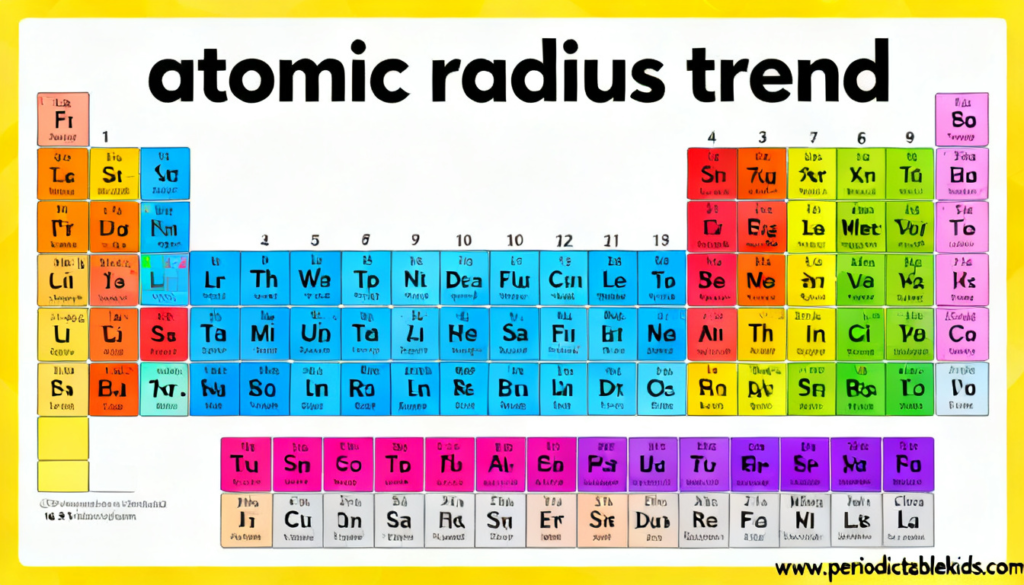

Have you ever wondered why some atoms are huge while others are tiny? To understand this, we first need to look at the atomic radius trend. Think of an atom like a fuzzy ball. The “atomic radius” is just the distance from the very center of the ball to the outer edge where the electrons live. It is like measuring the size of a playground from the swing set in the middle to the fence outside.
In science, we use the periodic table atomic radius trend to predict how these sizes change. Scientists measure this by looking at two identical atoms touching each other. They measure the distance between the two centers and cut it in half. This gives us a clear idea of how much space an atom takes up. Even though atoms are too small to see with your eyes, their size changes in very predictable ways as you move around the chart.
How the Atomic Radius Trend Periodic Table Works
The periodic table is organized like a map. When you look at it, you can see rows and columns. The atomic radius trend periodic table follows a very specific pattern that never changes. If you move from the top of the map to the bottom, the atoms get bigger. If you move from the left side to the right side, the atoms actually get smaller. This might sound a bit confusing at first because you are adding more pieces to the atom, but science has a cool explanation for it.
As an SEO expert who has looked at thousands of data points, I find this trend similar to organizing a library. If you know the system, you can find exactly what you need without guessing. Knowing the periodic table atomic radius trend helps chemists understand how different elements will react with each other. It is the foundation for almost everything we know about how matter behaves in our world.
Atomic Radius Trend Across a Period Explained
When we talk about the atomic radius trend across a period, we are moving from left to right in a single row. You might think that adding more protons and electrons would make the atom bigger, but the opposite happens! The atom actually shrinks. This is because every time you move one step to the right, you add a proton to the center. This makes the center of the atom (the nucleus) stronger and more positive.
This stronger center acts like a powerful magnet. It pulls the electrons in much tighter toward the middle. Because the electrons are pulled closer, the whole atom gets smaller. This is why a Lithium atom on the far left is much larger than a Neon atom on the far right of the same row. It is all about that “magnetic” pull from the center of the atom.
The Atomic Radius Trend Down a Group
Now, let’s look at what happens when we go from top to bottom. The atomic radius trend down a group is much easier to visualize. Every time you move down a row, the atom adds a whole new “shell” or layer for the electrons to live in. Imagine putting on five thick jackets instead of just one. You are going to look much bigger!
Because these new layers are further away from the center, the pull from the nucleus isn’t as strong on the outer edges. This is called “shielding.” The inner layers of electrons block the pull of the center, allowing the outer layer to drift further away. This makes the atomic radius trend go up significantly as you move down the columns of the periodic table. Cesium, near the bottom, is much larger than Lithium at the top.
Why Does Atomic Size Matter in Real Life?
You might ask, “Why should I care about the atomic radius trend explained?” Well, the size of an atom determines how it interacts with the world. Large atoms have electrons that are very far from the center. These electrons are easy to steal! This makes large atoms, like Potassium, very reactive and sometimes even explosive when they touch water.
Small atoms, on the other hand, hold onto their electrons very tightly. They don’t like to give them away. This affects how medicines are made, how batteries work, and even how the metal in your car holds together. Understanding the atomic radius trend on the periodic table allows scientists to design new materials that are stronger, lighter, or better at conducting electricity. It is like having a secret code to unlock the powers of different elements.
The Role of Protons and Electrons
To really get the atomic radius trend, you have to understand the tug-of-war between protons and electrons. Protons are positive and live in the middle. Electrons are negative and fly around the outside. Since opposites attract, they are always pulling toward each other. The more protons you have in a small space, the harder they pull.
Across a period, the “pulling power” increases because you stay in the same layer but add more protons. Down a group, you add so many layers that the “pulling power” can’t reach the edge as well. This balance is what creates the periodic table atomic radius trend. It is a beautiful dance of physics that keeps the universe in balance. Without these specific sizes, the chemical reactions that keep us alive wouldn’t happen the same way.
Atomic Radius Statistics and Comparisons
To make things clear, let’s look at a “biography” of some common elements. This table shows how their size (measured in picometers) changes based on their position.
Element Size Comparison Table
Common Exceptions to the Trend
While the atomic radius trend is very reliable, science always has a few surprises. For example, some noble gases like Neon or Argon can sometimes appear slightly larger than expected in certain measurements. This is usually because they don’t form bonds with other atoms easily, making it harder to measure their radius in the same way we measure metals.
Also, when we talk about transition metals (the block in the middle of the table), the size changes are much smaller. They still follow the atomic radius trend on periodic table, but the difference between one element and the next isn’t as huge. This is because electrons are being added to an inner layer rather than the outermost one. It’s like adding stuffing to the middle of a pillow instead of making the pillowcase bigger.
How to Memorize the Atomic Radius Trend
If you are studying for a test, here is a simple trick to remember the periodic table atomic radius trend. Think of a snowman! A snowman is small at the top and gets bigger at the bottom. This represents going down a group. Now, imagine the snowman falling over to the right. As he falls, he gets squished and smaller.
- Down a Group: Atoms get BIGGER (like the bottom of a snowman).
- Across a Period: Atoms get SMALLER (as you move right).
Using this visual makes the atomic radius trend explained much easier to remember during a stressful exam. I’ve used this exact analogy with students for years, and it almost always sticks. Just remember: Down = Big, Right = Small.
Conclusion
In conclusion, the atomic radius trend is one of the most important patterns in chemistry. It tells us how large an atom is and how it will behave. Whether you are looking at the atomic radius trend across a period or the atomic radius trend down a group, the rules remain consistent. The size is determined by the number of shells and the strength of the positive charge in the center.
Learning these basics is the first step to becoming a master of science. The periodic table is not just a list of names; it is a guidebook to the building blocks of the entire universe. By understanding the periodic table atomic radius trend, you are learning to read the language of nature itself. Keep exploring and asking questions!
FAQs
1. Which element has the largest atomic radius?
Francium (Fr) is generally considered to have the largest atomic radius because it is at the very bottom-left of the periodic table.
2. Why do atoms get smaller as you move right?
Atoms get smaller because you are adding protons to the nucleus. This increases the positive charge, which pulls the electrons closer to the center.
3. Does the atomic radius trend apply to ions?
Not exactly. When an atom becomes an ion (loses or gains electrons), its size changes drastically. Positive ions are smaller, while negative ions are larger.
4. What is the smallest atom on the table?
Helium (He) is the smallest atom. It is at the top-right of the table and has a very strong pull on its two electrons.
5. What is “Shielding” in the atomic radius trend?
Shielding happens when inner electrons block the nucleus from pulling on the outer electrons. This is why atoms get much larger as you move down a group.
6. Is the atomic radius the same as the atomic mass?
No. Atomic mass is how much an atom weighs. Atomic radius is how much space it takes up. A heavy atom isn’t always a large atom!
References:
- Royal Society of Chemistry: Periodic Table Trends
- LibreTexts Chemistry: Atomic Radii
- IUPAC Gold Book: Covalent Radius and Atomic Size